
Axosomatic Sustainability Framework
From Sustainability Initiatives to Institutional Transformation
A nine-layer, SDG-aligned model for embedding sustainability across education strategy, governance, curriculum, teaching and learning, research and innovation, operations, reporting, ESG compliance, and continuous improvement.
The Sustainability Activity Trap
Many universities can point to sustainability activity: recycling campaigns, student events, solar panels, awareness weeks, research projects, and references to the United Nations Sustainable Development Goals on websites and reports. These activities matter. But activity is not the same as transformation.
The real question is not whether a university has sustainability initiatives. The real question is whether sustainability has changed the operating logic of the institution. Does it influence strategy? Does it shape academic programs? Does it guide procurement and capital planning? Does it appear in performance indicators, budgets, risk registers, research priorities, and student learning outcomes?
This requires a framework that connects global goals to institutional priorities, policies, actions, indicators, evidence, reporting, and improvement. Without this line of sight, sustainability remains fragmented. With it, sustainability becomes a core dimension of institutional effectiveness.
From Global Goals to Institutional Evidence
The United Nations Sustainable Development Goals provide the global reference point. Higher education provides the institutional engine. Universities educate future professionals, produce knowledge, operate large campuses, shape communities, influence employers, and support national development. This gives universities a unique role: they are both contributors to sustainable development and subjects of sustainability accountability.
The framework therefore starts with a simple implementation logic:
The purpose is not to claim alignment with all goals equally. The purpose is to identify where the university has the strongest responsibility, capability, and evidence of contribution.
The Framework at a Glance
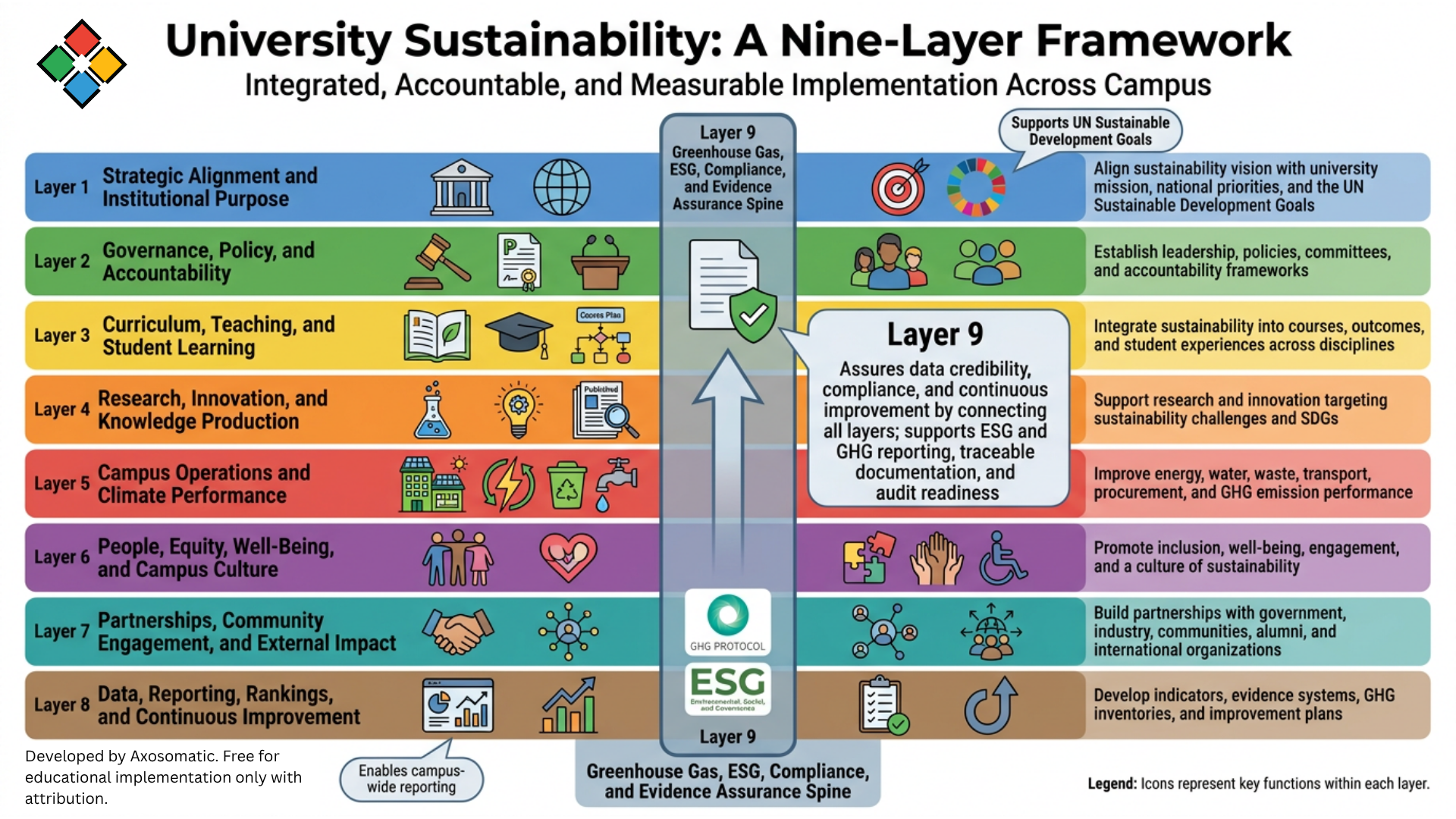
The Sustainable Higher Education Transformation Framework
The framework has nine layers. The first eight layers represent distinct institutional functions, while Layer 9 acts as a vertical cross-cutting spine for Greenhouse Gas, ESG, compliance, and evidence assurance.
Strategic Alignment and Institutional Purpose
Connect sustainability to the mission, vision, strategic plan, national priorities, and the long-term identity of the university.
Governance, Policy, and Accountability
Define ownership through policy, committees, decision rights, risk management, departmental plans, budget responsibilities, and review cycles.
Curriculum, Teaching, and Student Learning
Embed sustainability competencies across programs, general education, projects, internships, capstones, and applied learning experiences.
Research, Innovation, and Knowledge Production
Map research to sustainability challenges and support interdisciplinary work on climate action, energy, water, health, cities, education, and responsible technology.
Campus Operations and Climate Performance
Measure and reduce emissions, energy use, water use, waste, transport impacts, procurement impacts, and building life cycle impacts.
People, Equity, Well-Being, and Campus Culture
Promote inclusion, access, health, safety, student support, staff development, accessibility, and responsible campus behavior.
Partnerships, Community Engagement, and External Impact
Use the university as an anchor institution through partnerships with government, schools, industry, civil society, alumni, and international organizations.
Data, Reporting, Rankings, and Continuous Improvement
Build dashboards, annual reports, greenhouse gas inventories, Sustainable Development Goals evidence files, ranking evidence, and improvement action plans.
Greenhouse Gas, ESG, Compliance, and Evidence Assurance Spine
Serve as the vertical cross-cutting layer that connects all eight implementation layers through credible data, traceable evidence, regulatory compliance, ESG reporting, Greenhouse Gas reporting, assurance files, and audit-ready documentation.
Do Not Treat All Goals as Equal Reporting Boxes
A common mistake is to mention all seventeen goals without clarifying the university’s real level of responsibility and evidence. A stronger approach is to classify the goals into three groups: core academic goals, operational performance goals, and social impact goals.
Group One
Core Academic Goals
Goals directly linked to the university mission, student learning, knowledge production, innovation, and global citizenship.
Group Two
Operational Performance Goals
Goals linked to the campus footprint, resources, emissions, energy, water, buildings, waste, procurement, and mobility.
Group Three
Social Impact Goals
Goals linked to equity, well-being, inclusion, decent work, institutional integrity, and community contribution.
This classification helps the university avoid superficial reporting. It also allows leadership to focus resources on the goals where the institution can produce credible, measurable, and distinctive impact.
What Makes the Framework Work
The nine layers require institutional enablers. These enablers cut across every academic and administrative unit.
Leadership Commitment
Senior leadership must position sustainability as a strategic responsibility, not a peripheral committee activity.
Data Infrastructure
The university needs reliable data on emissions, energy, water, waste, procurement, curriculum, research, engagement, and impact.
Financing and Resource Allocation
Sustainability must appear in budgets, capital planning, procurement decisions, and investment priorities.
Stakeholder Engagement
Students, faculty, staff, employers, alumni, government, and community partners should be part of the sustainability system.
Quality Assurance and Improvement
Sustainability should follow a disciplined cycle of planning, implementation, measurement, reporting, review, and improvement.
How a University Can Start
The framework can be implemented in phases. The sequence matters because weak governance and weak data will undermine even well-designed sustainability initiatives.
Phase One
Diagnose the current state
Review strategy, policies, governance, campus data, curriculum, research, community engagement, and existing evidence against the framework layers.
Phase Two
Define priorities and ownership
Select priority goals, assign accountable owners, approve policy direction, and establish the sustainability performance architecture.
Phase Three
Build the evidence system
Develop indicators, data sources, dashboards, greenhouse gas inventory methods, evidence repositories, and reporting templates.
Phase Four
Improve and institutionalize
Use annual reviews to improve actions, budgets, teaching, research, operations, rankings evidence, and public sustainability reporting.
This roadmap allows sustainability to mature from scattered initiatives into a managed institutional capability.
Credibility Depends on Evidence
The credibility of sustainability in higher education depends on evidence. A university should be able to show what changed, who was responsible, what data was used, how performance was reviewed, and how results informed improvement.
This is especially important for greenhouse gas reporting, ESG reporting, institutional strategy, quality assurance, sustainability rankings, and public communication. Without evidence, sustainability becomes narrative. With evidence, it becomes governance.
For higher education, the future of sustainability is not a separate report, a separate office, or a separate campaign. It is an integrated institutional system that connects purpose, performance, accountability, and impact.
Work with Axosomatic
Turn sustainability into a measurable institutional system.
Axosomatic helps universities apply the framework through strategy alignment, Greenhouse Gas and ESG reporting, evidence systems, dashboards, and continuous improvement.
© Dr. Nabeel Murshed · Axosomatic Innovation · 2026
Free for non-commercial institutional use with attribution.